
How Design and Manufacturing Jointly Define Luxury Custom Joinery Quality from Vision to Reality?
In the design of luxury residential and commercial spaces, an exceptional proposal often starts with a deep understanding of aesthetics, functionality, and lifestyle. However, between design drawings and the physical space lies an undeniable bridge—manufacturing.
A full-height feature wall, a floating joinery suite, a minimalist handle-less cabinet door, or a complex curved structure—what appears on the surface to be merely design expression involves underlying manufacturing considerations: material characteristics, structural mechanics, machining precision, connection details, and site installation conditions.
Design determines how a space is expressed, while manufacturing dictates whether that expression can be realized with absolute accuracy.
For high-end custom joinery, design and manufacturing have never been two isolated silos. A truly mature custom capacity bridges creativity with materials, craftsmanship, and production systems right from the conceptual phase, forming a complete closed loop between design aesthetics and real-world application.

A rendering can depict ideal spatial proportions, material textures, and light-shadow interactions. However, once moving into the production phase, every design detail must be translated into explicit product structures and machining specifications.
For example, large floor-to-ceiling joinery must account for door panel dimensions, structural stability, and hardware load capacities; handle-less designs require early planning for opening mechanisms, panel gap proportions, and installation alignment; continuous transitions between wall paneling and cabinetry demand precise handling of dimensional tolerances, perimeter closures, and joinery details across different materials.
If these issues are only discovered during production or site installation, they invariably result in design revisions, material waste, or costly on-site rework.
Therefore, a manufacturing mindset must be integrated into the design stage:
• Structural Feasibility: Do product dimensions, thicknesses, connection methods, and load-bearing relationships satisfy actual usage demands?
• Material Compatibility: Can different surface finishes, carcass substrates, and structural forms satisfy both visual expectations and machining requirements?
• Craftsmanship Feasibility: Do curved panels, edge-banding, cutouts, and miters possess corresponding manufacturing conditions?
• Installation Smoothness: Are reasonable installation tolerances and adjustment allowances reserved between joinery, wall framing, flooring, bulkheads, and other architectural elements?
Great design is not constrained by manufacturing conditions; rather, by understanding manufacturing logic, it secures a far more reliable path toward realization.
When designers select a material, they choose not only its color and grain texture, but also its corresponding structural performance, machining techniques, and final expression.
Across timber finishes, natural wood veneers, PET, polyurethane lacquers, and melamine exhibit distinct characteristics in grain expression, gloss levels, tactile feel, and processing methods. Applying different materials across expansive wall paneling, cabinet doors, or accent detailing generates varying visual results and manufacturing demands.
For instance:
Natural Wood Veneer emphasizes organic grain and depth, requiring close attention to grain direction, matching methods (book-matching/slip-matching), and overall color harmony.
Polyurethane Lacquer delivers a smooth, flawless surface, imposing strict requirements on substrate preparation, coating processes, and surface quality control.
PET / EB Finishes offer versatile surface performance, meeting the needs of modern minimalist spaces for unified color, texture, and consistency.
Aluminum-Framed Glass Systems require holistic integration of metal profiles, glass specifications, joinery fittings, and spatial proportions.
Consequently, material selection cannot remain confined to renderings. Design proposals must align with material characteristics, machining conditions, and crafting capabilities to balance visual presentation with daily utility.
BAODAO Home has established a comprehensive product ecosystem spanning melamine, lacquer, wood veneer, PET/EB, aluminum-glass systems, and leather. We master core finishing techniques including lacquer coatings, natural timber veneering, and PET applications.
Simultaneously, through the application of German-imported PUR edge-banding, integrated color-matching design, 3D curved surface molding, and concealed (hole-free) connection techniques, we provide expanded possibilities for diverse spatial designs.
From material selection and surface treatments to product structure and joinery details, manufacturing craftsmanship not only impacts product durability, but also fundamentally dictates the refined texture that design ultimately expresses.
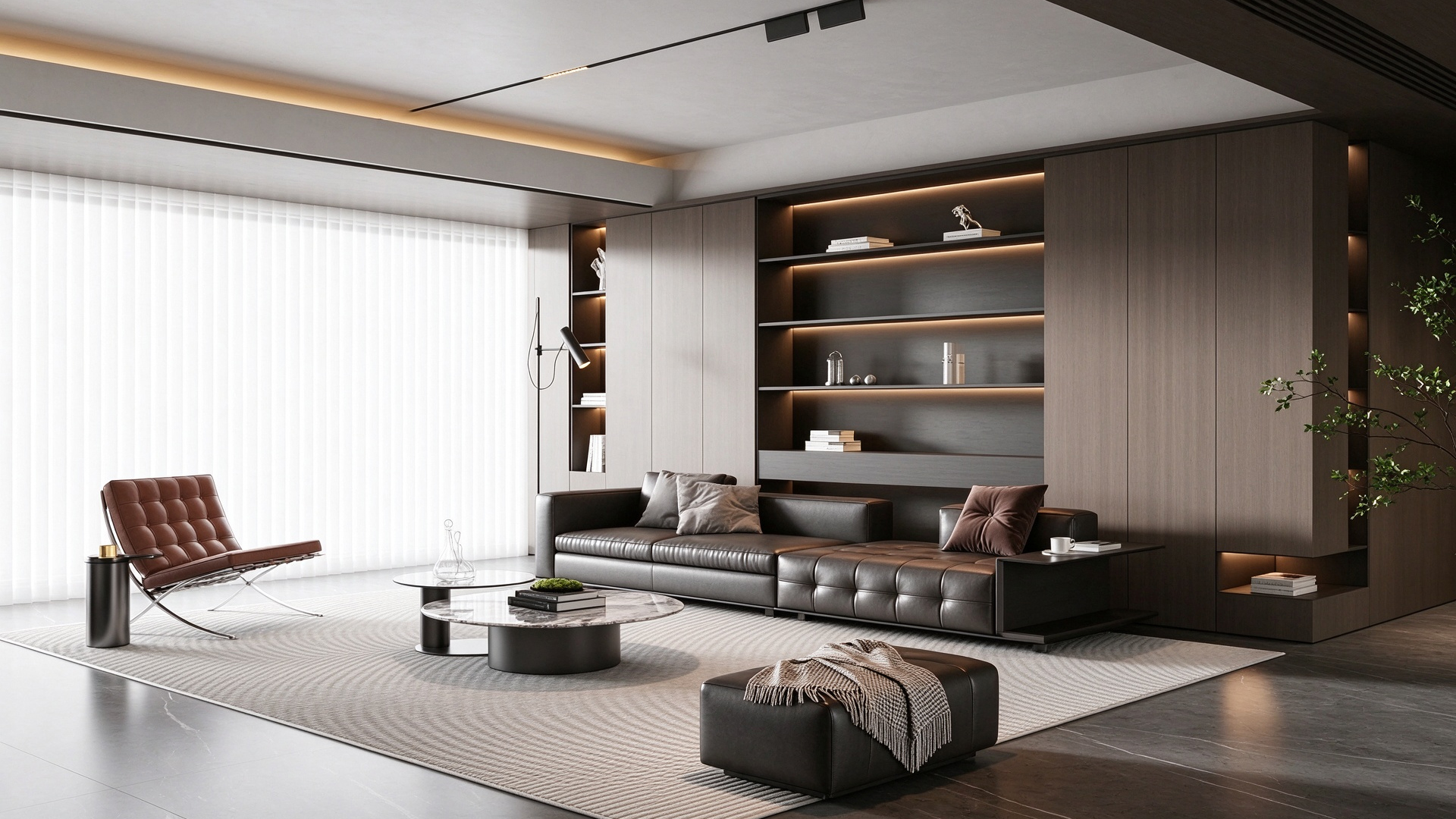
In contemporary luxury residential design, minimalist aesthetics, handle-less joinery, integrated door-wall-cabinet systems, and concealed storage are attracting ever-increasing attention.
These designs appear to eliminate decorative elements, but in reality, they impose far higher demands on manufacturing precision.
When visual noise is stripped away, subtle details that were once easily overlooked become prominently exposed:
• Are the gaps between cabinet doors strictly uniform?
• Are the reveals and lines between door panels and wall paneling continuous?
• Are colors and grain textures across different materials harmonized?
• Is the edge-banding flawless and seamless?
• Are perimeter closures between cabinetry and architectural walls clean and natural?
• Do concealed connections balance sleek appearances with structural stability?
Particularly in integrated door-wall-cabinet projects, custom joinery ceases to exist as standalone furniture—it becomes an intrinsic part of the spatial envelope. Any dimensional variance, color shift, or poorly handled junction can compromise the overall visual effect.
This explains why high-end custom joinery places paramount importance on precision machining and standardized manufacturing.
Centering around our 100,000-square-meter production hub in Foshan, BAODAO Home has built a digitalized, large-scale manufacturing infrastructure equipped with over 15 specialized production lines and intelligent machinery, including German HOMAG machinery systems.
From precise board cutting and PUR edge-banding to CNC drilling, every production node revolves around strict product dimensions and crafting specifications. By eliminating information gaps between processes, design details are faithfully executed through a stable manufacturing workflow.
The simpler a design appears, the more it demands rigorous manufacturing control over dimensions, proportions, and craftsmanship details.
A defining characteristic of custom joinery is that every project features unique spatial dimensions, product combinations, material schedules, and functional specifications.
This means the manufacturing end must possess robust standardization capabilities while remaining agile enough to accommodate project-specific customization.
If design data fails to translate accurately into production, even the finest design scheme can suffer discrepancies during shop drawing breakdown, machining, sorting, and site installation.
The true value of digitalized manufacturing lies in establishing precise information pipelines between design and factory floors.
By connecting design software with production management systems, product dimensions, panel specs, machining coordinates, and order data are systematically converted into execution parameters. Combined with ERP/MES management software and barcode tracking systems, information linkages across orders, individual panels, and manufacturing steps are strictly maintained.
With in BAODAO Home’s manufacturing ecosystem, digital management operates in synergy with smart manufacturing—covering board cutting, edge-banding, CNC drilling, sorting, factory pre-assembly, and flat-pack packaging.
This synergy elevates process coordination while providing systematic support for managing multi-category, bespoke custom orders.
Truly mature custom manufacturing does not mean making every product identical; rather, it uses standardized equipment, refined processes, and digital workflows to deliver dependable production support for diverse design visions.
Synergy between design and manufacturing must not terminate when products leave the factory gates.
In custom joinery projects, products ultimately enter real-world architectural spaces to interface with walls, floors, bulkheads, and other functional building components. Whether initial design detailing was thorough, production dimensions were exact, and structural designs were sound will all be tested during on-site installation.
Therefore, a complete custom delivery workflow must seamlessly link shop drawing detailing, material approval, factory manufacturing, quality inspection, factory pre-assembly, protective packaging, logistics transport, and site installation guidance.
Collaborating with global homeowners, design studios, architects, builders, and property developers, BAODAO Home has established a structured Six-Step Delivery Workflow: Consultation、Conceptual Scheme、Finalization & Shop Drawings、Production、Global Delivery 、 On-Site Installation.
Prior to final dispatch, 1:1 factory pre-assembly and debugging are conducted to inspect joinery structures, hole coordinates, hardware fittings, and assembly alignments—resolving potential risks directly on the factory floor. Subsequently, specialized protective packaging and logistics ensure a smooth transition to site installation and final sign-off.
For complex projects such as luxury villas, boutique hotels, and overseas residential estates, this end-to-end connected workflow is especially vital.
A complete design outcome extends beyond visual expression on paper—it guarantees that once products are installed on site, the original design intent is accurately and faithfully brought to life.
Design and manufacturing may seem to belong to different domains, but together they define the ultimate quality of luxury custom joinery.
Design endows a space with aesthetics and identity; materials supply texture and expression; craftsmanship translates creativity into tangible products; while digitalized production and professional delivery ensure these achievements are reliably presented within physical spaces.
For BAODAO Home, custom joinery is far more than product design and manufacturing; it is a systematic process that originates from spatial needs, integrating design, materials, craftsmanship, production, and installation into a seamless whole.
Great design understands how it is manufactured; great manufacturing understands and realizes the design.
When creativity and manufacturing truly align, custom joinery ceases to be mere dimensional adjustments—it empowers every spatial vision to seamlessly transition into real-world living.

Block Quote