
In contemporary high-end residential design, materials are no longer merely decorative elements — they are essential components in shaping a space's character, visual layering, and living experience.
Wood brings warmth and nature, glass lends transparency to a space, and metal presents a modern sensibility through its refined sheen and crisp lines. The three materials have distinctly different visual characteristics, yet they frequently appear together in high-end residences, hotels, and commercial spaces.
However, the richer the material palette, the more it tests the overall design's coordinating ability. Without reasonable control of proportion, color, and detailing, different materials can easily create visual conflict, making a space feel fragmented — even losing its original sense of wholeness.
So how should glass, metal, and wood be combined to retain their individual textures while forming a unified and layered spatial expression?
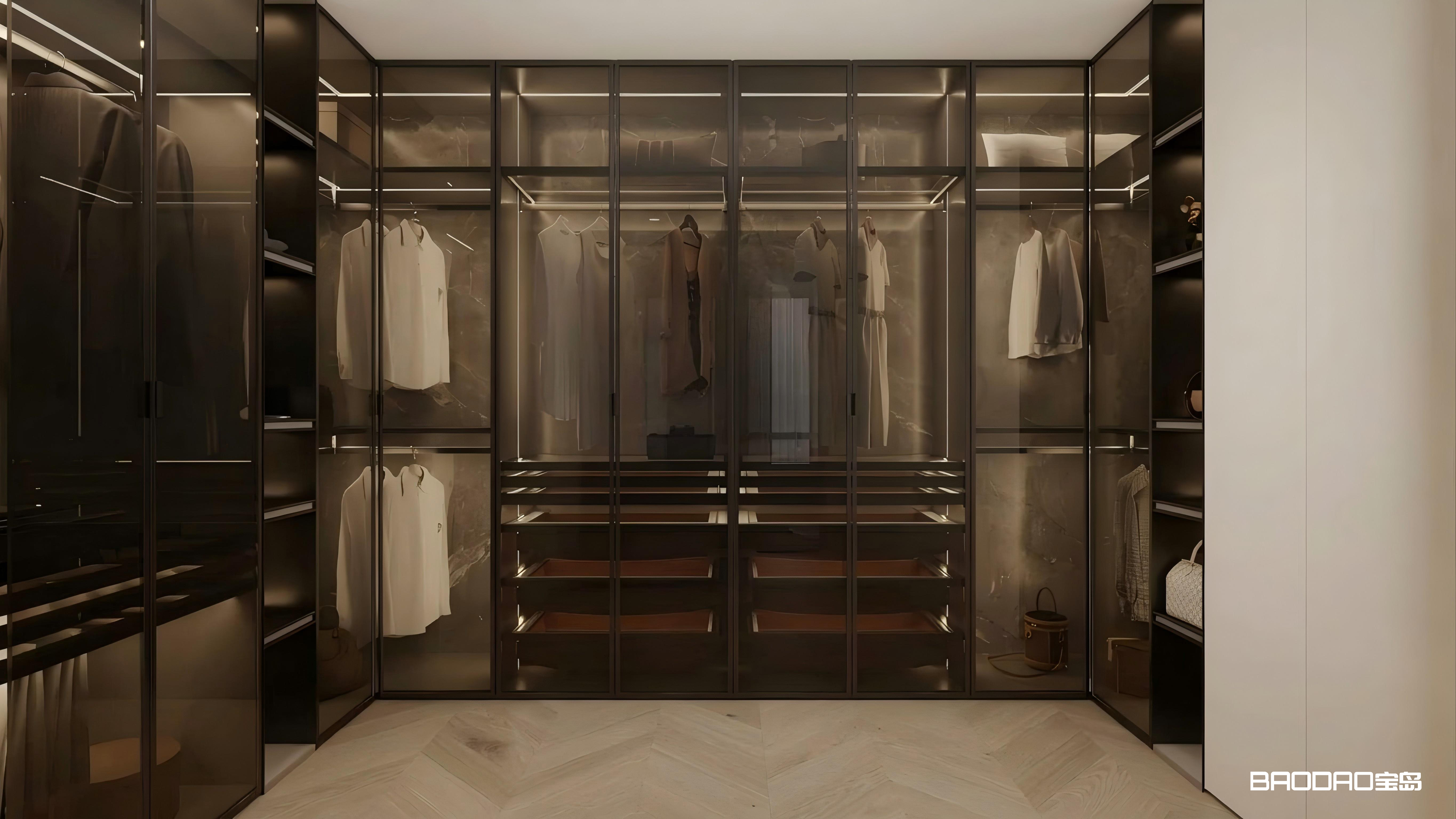
Different materials speak different visual languages.
With its natural grain and warm touch, wood brings approachability and a natural atmosphere to modern spaces. Whether light oak, dark walnut, or smoked veneer, wood can present different spatial moods through variations in grain direction, color depth, and surface treatment.
Glass, with its light and transparent visual character, softens the visual weight of spatial boundaries, allowing natural light to flow between areas. Through different types — clear, ultra-clear, fluted, or bronze-tinted glass — it creates rich visual effects.
Metal more often serves as an expression of lines and details. Whether cabinet door frames, glass partition trim, or local decorative elements, metal adds a sense of order and modernity to a space through refined edge detailing.
From a visual-relationship perspective, the three materials complement one another precisely:
Wood creates warmth, glass extends the space, and metal establishes order.
They are not simply stacked together; rather, their distinct properties balance one another, giving the space both natural warmth and the refinement of modern design.
When multiple materials are combined, proportion often matters more than the materials themselves.
If wood, glass, and metal occupy similar visual weight within one space, the result is often a lack of clear focus. In limited-area residential spaces especially, excessive material variation can break the originally coherent visual relationship.
Therefore, in overall design, it is necessary to first establish the primary material, then use the other materials as supplements.
For example, use wood veneer as the main visual tone of the space, forming a continuous material language through large-area cabinets, walls, or interior doors; introduce glass cabinet doors or glass partitions in local areas to increase transparency; and finally use metal frames, trim, or hardware details as accents.
This approach allows the space to retain a clear visual mainline while gaining layering through local variation.
For modern residences that emphasize overall coherence, more materials are not necessarily better. Truly mature combinations give each material an appropriate position and role.

Harmony between materials depends not only on types and proportions, but also closely on color, gloss level, and surface texture.
Take wood alone: light oak creates a relaxed, natural atmosphere, while dark walnut more readily conveys a composed, understated spatial character. The color and transparency of glass also affect the overall visual effect. Clear glass preserves transparency to the greatest extent; bronze-tinted glass appears softer; and fluted glass adds a hazy quality through its textured variation.
Metal likewise offers different visual expressions. Brushed metal typically presents a fine, restrained texture, while high-polish metal has a more pronounced reflective effect. Different surface treatments affect how well metal blends with wood and glass.
In actual pairing, unity can be established from the following aspects:
Color echo: Keep the metal finish connected with other details in the space — for example, echoing through cabinet frames, lighting fixtures, or door handles — to prevent metal elements from appearing too abrupt.
Gloss balance: When the space already features large areas of glass or high-gloss finishes, matte wood veneers or brushed metal can be added appropriately to avoid excessive reflective elements.
Texture coordination: Wood has a pronounced natural grain. When pairing it with glass and metal, avoid introducing too many complex surface patterns at once, allowing appropriate visual breathing room between the different materials.
Materials don't need to be identical — but they need to form connections in color, texture, and visual rhythm.
In actual spatial design, glass, metal, and wood rarely exist independently.
They may appear together in a single display cabinet, or form continuous spatial interfaces through different products such as interior doors, wall panels, wardrobes, and partitions.
For example, in a living room, a wood veneer feature wall can establish the overall tone of the TV wall; locally integrated glass display cabinets add transparency; and metal frames outline the cabinet contours — allowing display and storage functions to blend naturally.
In walk-in wardrobe or sideboard areas, glass cabinet doors reduce the visual weight of large cabinet surfaces, while metal frames give the door structure greater clarity. Wooden cabinet bodies and internal shelves provide a stable visual base, creating a distinctly layered effect.
In interior door and wall systems, wood veneers, metal trim, and local glass elements can also be combined, maintaining a unified design language between different functional zones.
This is where the value of integrated door-wall-cabinet design lies.
When different products are no longer treated as standalone furniture but planned as part of an overall spatial system, materials, colors, proportions, and details can form coherent relationships across different areas.
Built around interior doors, wall panels, and full cabinetry, Baodao Home has established a multi-category custom product system covering different product series including lacquer-free, painted, wood veneer, PET/EB, aluminum-wood-glass, and leather.
Among them, the aluminum-wood-glass system combines metal structures, glass materials, and wood elements, offering richer combination possibilities for spaces. Through different finishes, colors, and structural forms, it adapts to various application needs such as display storage, spatial partitioning, and full cabinetry.
From a single product to a complete space, the relationship between materials thus gains far more design possibilities.

The design stage defines the relationships between materials, but the final presentation still depends on the product's machining precision and detailing.
Especially when glass, metal, and wood are combined within a single custom product, the connections, trim details, and dimensional matching between different materials all affect the final quality.
For example, glass and metal frames require sound structural design and dimensional control; between wooden cabinet bodies and metal frames, material thickness, installation methods, and joint details must be considered; and the colors and textures of different finishes need unified planning at both the design and production stages.
These details may seem minor, yet they directly affect the completeness of the product.
For high-end custom joinery, combining materials is not simply piecing different components together — it requires the joint participation of design, product detailing, and manufacturing craftsmanship.
Only when design expression and manufacturing capability connect effectively can the combination of materials transform from a visual effect on drawings into real, complete, quality spatial details.

The combination of glass, metal, and wood may appear to be a matter of pairing materials — but in essence, it reflects an understanding of the space's overall relationships.
Wood gives a space warmth, glass makes it lighter, and metal establishes order through lines and structure. There is no fixed formula for combining the three. What truly matters is finding the right proportions and forms of expression according to the space's function, design style, and usage needs.
From the material combination of a single cabinet, to the system design of an entire wall, to the visual connection between different spaces, the value of materials lies not only in their own texture, but in how they collectively serve the space.
For custom joinery, this also means design cannot stop at the selection of a single product — it must start from the overall space, coordinating materials, products, structures, and manufacturing craftsmanship.
Good material pairing does not make every material the protagonist — it lets them enhance one another in their rightful positions, together forming a complete, harmonious living space with lasting quality.

Block Quote