
In modern luxury whole-house customization and minimalist interior design, floor-to-ceiling tall cabinets, integrated door-wall-cabinet systems, and handleless door panels have become major trends. However, many homeowners encounter a frustrating problem within six months to a year of moving in: cabinet doors begin to warp, fail to close tightly, exhibit expanding gaps, or even rub against the cabinet frame or adjacent door panels during opening and closing.
Faced with this phenomenon, many people's first reaction is that "the hardware wasn't adjusted properly" or "the installer lacked craftsmanship." In reality, 80% of cabinet door warping stems from improper core material selection and a lack of matching physical stress-balancing engineering.
Cabinet doors are neither "the more expensive, the better" nor "the larger, the better." Understanding the truth about the warp resistance of different core materials is the first step toward creating high-texture, long-lasting joinery spaces.
Different wooden core materials possess distinctly different physical structures and internal stress characteristics. When manufacturing cabinet doors—especially extra-tall floor-to-ceiling doors exceeding 2.4 meters in height—the performance of various core materials differs significantly:
• Physical Structure: Utilizes staggered, overlapping wood fibers or particle structures, with no uniform directional stress inside.
• Performance: Low water-absorption swelling rate, excellent structural stability, and strong resistance to bending.
• Application Scenarios: Premium high-density OSB or oriented structural boards are currently among the most recommended core materials for producing extra-tall floor-to-ceiling door panels from 2.4 to 2.8 meters.
• Physical Structure: Formed by gluing multiple layers of single veneers together in alternating grain directions.
• Performance: Moisture resistance and screw-holding power are exceptional, performing brilliantly for cabinet bodies or standard door panels within 2 meters.
• Common Misconception: Many homeowners believe that "plywood is better than particle board." However, when making extra-tall door panels above 2.4 meters, plywood has a higher probability of single-direction warping than uniformly structured OSB due to uneven physical pull among the internal veneer layers.
• Physical Structure: Made by breaking down wood fibers and hot-pressing them with adhesives, resulting in a uniform density.
• Performance: Surface flatness is extremely high with no granularity, making it the single best core material for complex milled profile doors, PET finishes, and lacquered doors.
• Potential Risks: Heavy in weight and prone to water expansion; if used for extra-tall doors, it places extremely high requirements on board quality, moisture-proof edge banding, and hardware load-bearing capacity.
• Physical Structure: Retains the natural moisture swelling and dry shrinkage characteristics of natural timber.
• Performance: Natural texture, but internal wood fibers expand and contract drastically with changes in air humidity.
• Potential Risks: Without a framework structure (such as mortise-and-tenon framed panel doors), using large-area solid wood flat panels directly for tall cabinet doors makes them extremely prone to warping or cracking.
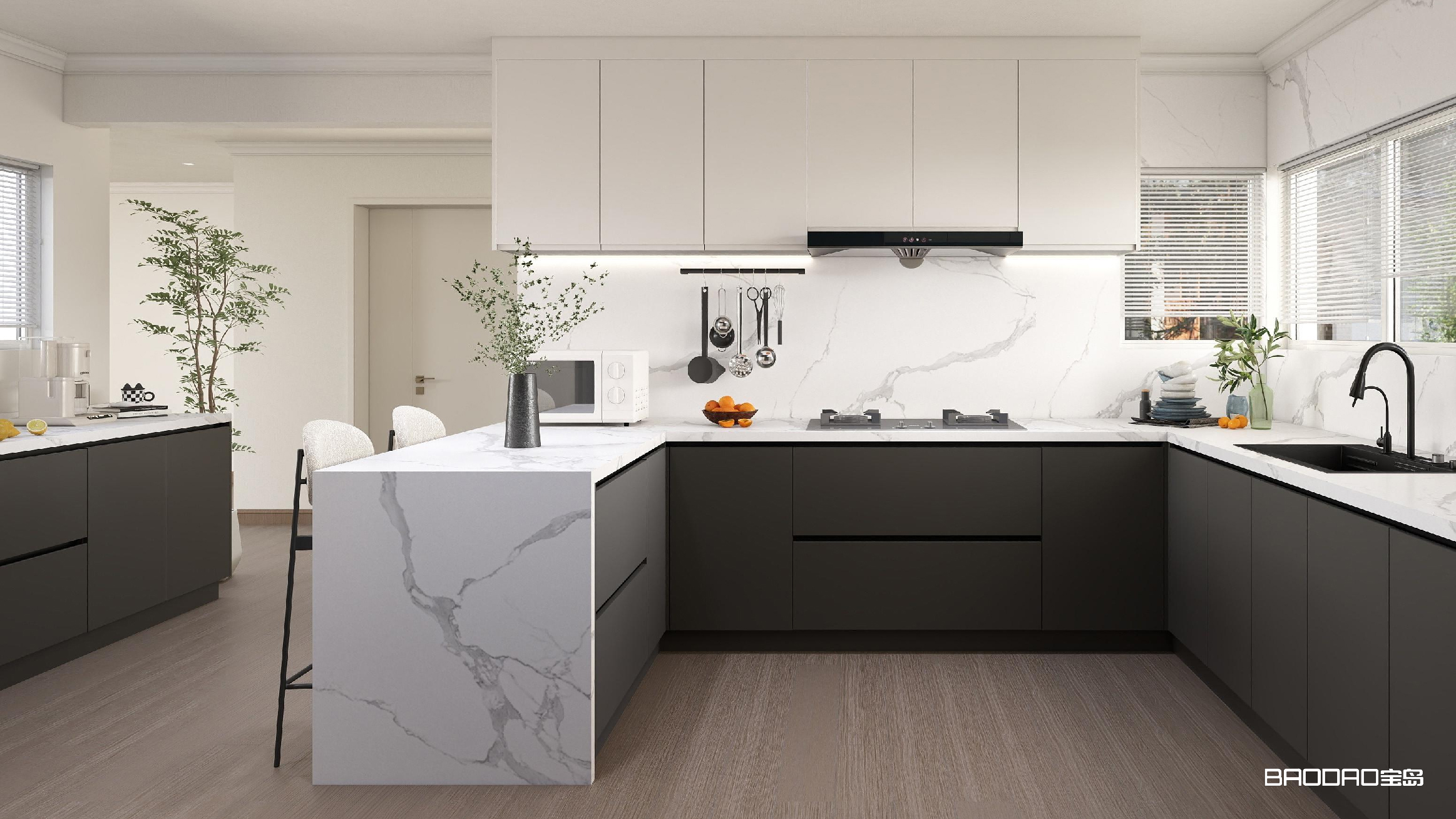
Selecting the right core material alone is not enough. Extra-tall floor-to-ceiling doors pursue minimalist aesthetics, but rely on rigorous physical stress-balancing engineering behind the scenes. The following 3 details determine whether a cabinet door can withstand the test of time:
One of the triggers for board warping is water vapor from the air seeping into the board interior through gaps, leading to localized board expansion and an imbalance of internal stress.
Baodao Craft: All series are equipped with German imported Jowat PUR edge banding technology, controlling glue line thickness within 0.1mm. The rigorous glue layer efficiently blocks external water vapor ingress, significantly attenuating the impact of environmental humidity changes on internal board stress.
Much cabinet door warping occurs because the pulling force on the front and back sides is inconsistent. For example: the front side features a thick wood veneer or lacquer finish, while the back side features only a thin, ordinary finish layer.
Engineering Standard: Premium cabinet door manufacturing requires that the finish material, thickness, and craft on both the front and back sides must be completely identical (identical material and thickness on both sides), forming symmetrical physical pull to offset bending tendencies mutually.
For floor-to-ceiling doors exceeding 2.4 meters in height, configuring a physical adjustment straightener is recommended regardless of which core material is chosen.
Working Principle: By embedding metal tension rods into the back of the door panel and adjusting prestress via bolts, the natural physical bending of the wood caused by seasonal temperature and humidity changes is offset.
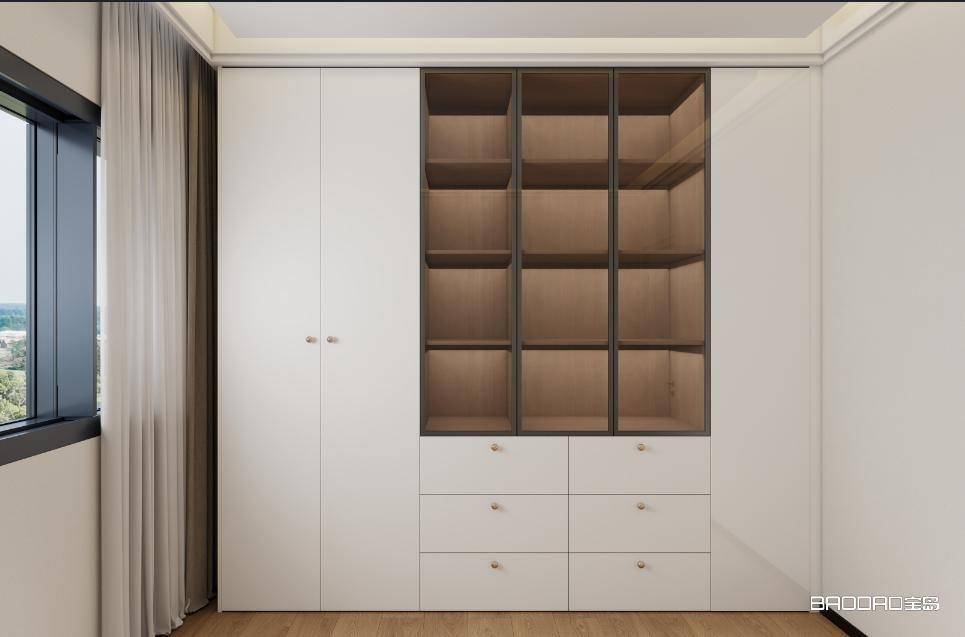
The selection of core materials must ultimately respond to specific usage environments.
In humid spaces such as kitchens and bathrooms, the moisture-proof performance of core materials is paramount. Water vapor, oil fumes, and temperature fluctuations continuously erode cabinet door edges and internal structures. Beyond superior edge banding craft, the moisture-proof density and glue-soaking saturation of the core material itself determine whether it can remain stable long-term in these environments.
In underfloor heating environments, rising ground temperatures in winter cause a temperature difference between the bottom and top of the cabinet body, triggering uneven thermal expansion and contraction. If the thermal expansion coefficient of the core material is too high, or if internal structural stress release is insufficient, cabinet doors are prone to warping. Core materials with multi-layer structures and oriented strand structures maintain better stability in underfloor heating environments than single-structure fiberboards due to more uniform internal stress distribution.
In overseas projects, climate differences present an even harsher test for core materials. The oceanic climates of Melbourne and Sydney exhibit high humidity, with pronounced diurnal temperature variations and seasonal humidity changes; the Middle East region, on the other hand, is hot and dry with intense ultraviolet radiation. In actual projects, targeted adjustments should be made regarding core material selection, moisture content control, and surface treatment based on the climatic characteristics of the project location, ensuring cabinet bodies maintain stable forms across cross-climatic environments.
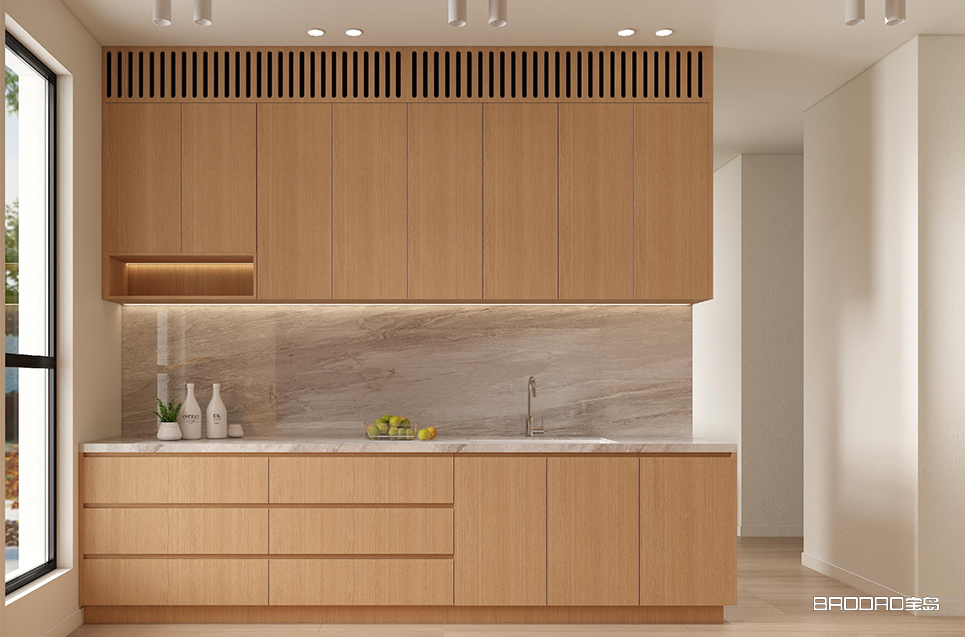
As a brand focusing on high-end whole-house customization and cross-border engineering delivery, Baodao Home relies on its intelligent manufacturing base covering approximately 100,000 square meters in Foshan to advance the anti-warping defense line of cabinet doors to the very first link of manufacturing:
• Strict Board Conditioning and Moisture Content Control: Before cutting, core materials undergo strict temperature and humidity environmental conditioning to eliminate residual internal stress, ensuring moisture content meets the climate standards of the destination.
• German High-Precision Processing: Utilizing imported CNC intelligent cutting and edge banding equipment to ensure the cutting-edge perpendicularity and edge banding tightness of every door panel reach millimeter-level standards.
• Pre-Assembly and Debugging Prior to Delivery: For high-difficulty, high-end custom projects such as extra-tall doors and hidden transit doors, factory pre-assembly debugging and flatness inspections are conducted before leaving the factory, eliminating warping risks during overseas and site installation in advance.
There is no single absolutely perfect core material, only a systematic combination best suited to specific space, dimension, and craft requirements. By avoiding the major pitfalls of core material selection and processing craft, minimalist and elegant cabinet doors can remain as flat as new through the passage of time.

Block Quote