
In contemporary interior design, modern Italian style is often regarded as a sophisticated expression that balances rationality and aesthetics. However, in practice, a common misconception is to simply equate it with “minimalism.” While the two share certain visual similarities—such as clean spatial surfaces, restrained color palettes, and reduced ornamentation—this understanding becomes overly simplistic when examined from a design logic perspective.

The essence of minimalism lies in “reduction,” emphasizing the removal of unnecessary elements to achieve a pure spatial experience, with the goal of creating lightness and tranquility. In contrast, modern Italian design is rooted in “control.” Rather than indiscriminately eliminating elements, it carefully orchestrates materials, proportions, and structures while retaining what is necessary, allowing the space to maintain richness in layers and details within a restrained framework. This fundamental difference is what ultimately distinguishes their final expressions.

In practice, many spaces lack the expected sense of refinement not because of material choices, but due to the absence of a coherent organizational logic. For instance, relying solely on a single material or color to create a “clean” look often results in flat and monotonous spaces with little depth. In modern Italian design, materials are never treated in isolation; instead, they work in contrast to establish an overall order—such as the interplay between the hardness of stone and the softness of textiles, the balance between the coolness of metal and the warmth of wood, and the subtle variation between smooth finishes and natural textures. These contrasts are essential in creating spatial depth.

Beyond materiality, proportion is another critical factor that defines spatial quality. Many spaces that appear to use high-end materials still fail to convey a sense of sophistication due to imbalanced proportions. A lack of integration between cabinetry and walls, mismatched furniture scale relative to the space, and poorly distributed open and closed elements can all weaken the overall sense of order. By contrast, modern Italian design emphasizes holistic control to establish visual stability—through full-height cabinetry, lowered visual centers of gravity, and the reduction of unnecessary linear divisions—resulting in a more unified and cohesive spatial expression.
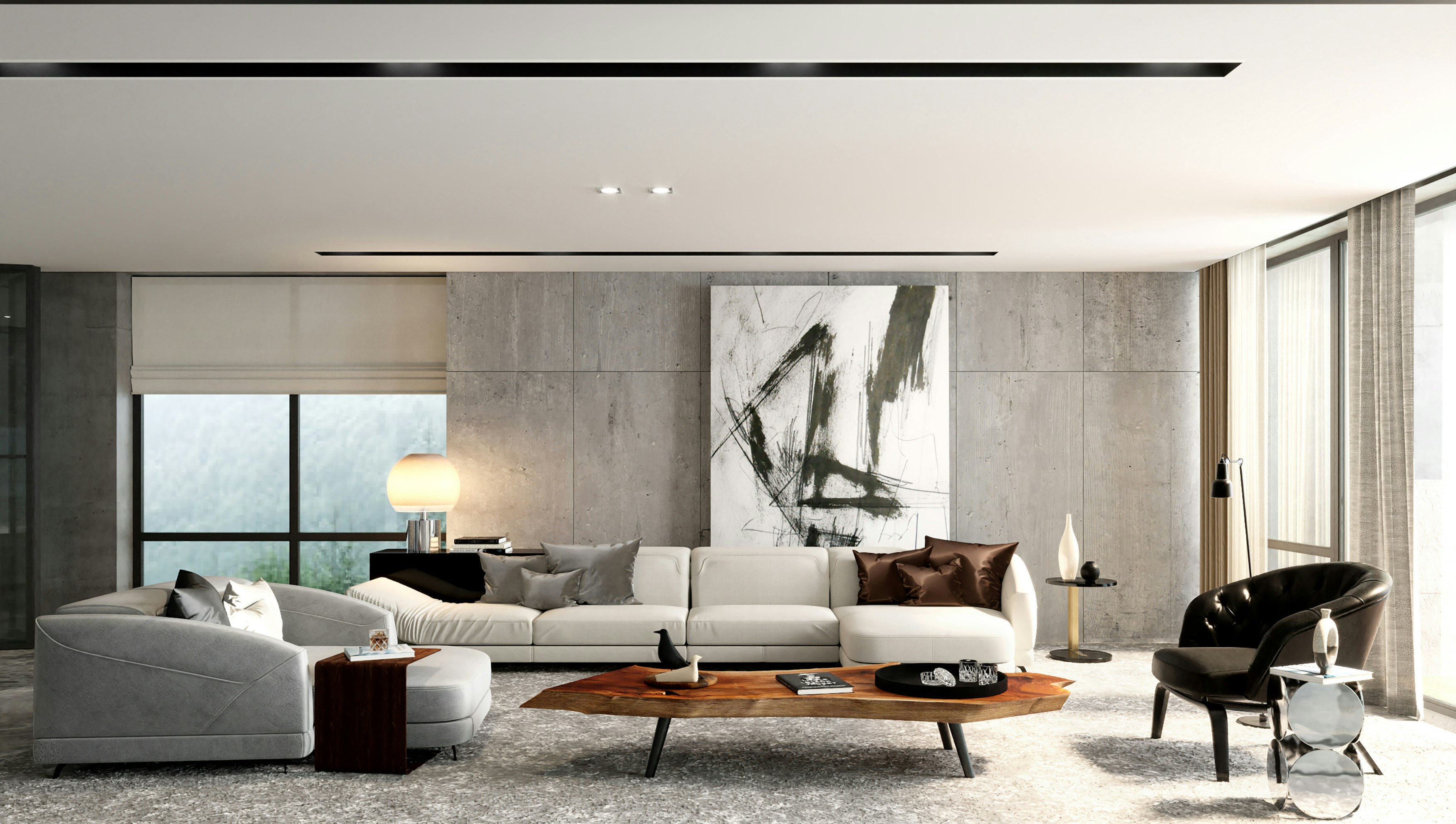
A deeper distinction lies in the method of spatial construction. Traditional interiors are often furniture-led, where pieces are added into a space after the fact. Modern Italian design, however, begins with the spatial structure itself, integrating furniture and functional systems into a unified whole. In this approach, cabinetry is no longer an additive element but becomes part of the architectural framework. Through built-in solutions, integrated wall systems, and softened boundaries, the space evolves from a collection of objects into a cohesive entity. The visual clarity achieved is a direct result of this structural integration.

As living standards continue to rise, modern Italian style is evolving from a purely aesthetic choice into a more systemized spatial solution. The focus is shifting from localized refinement to overall coherence, functionality, and long-term usability. In this context, whole-house customization becomes increasingly valuable. Through a system-based approach, it enables the unification of material language, precise control of proportions, and the integration of storage with spatial structure, resulting in environments that are both functionally clear and visually ordered.
Ultimately, the sense of sophistication associated with modern Italian design does not stem from the reduction of elements, but from the establishment of order within complexity. It does not pursue emptiness, but rather balance—allowing spaces to remain rich within restraint and layered within unity. This holistic, space-oriented design philosophy is gradually becoming a defining direction in contemporary home design.
Block Quote